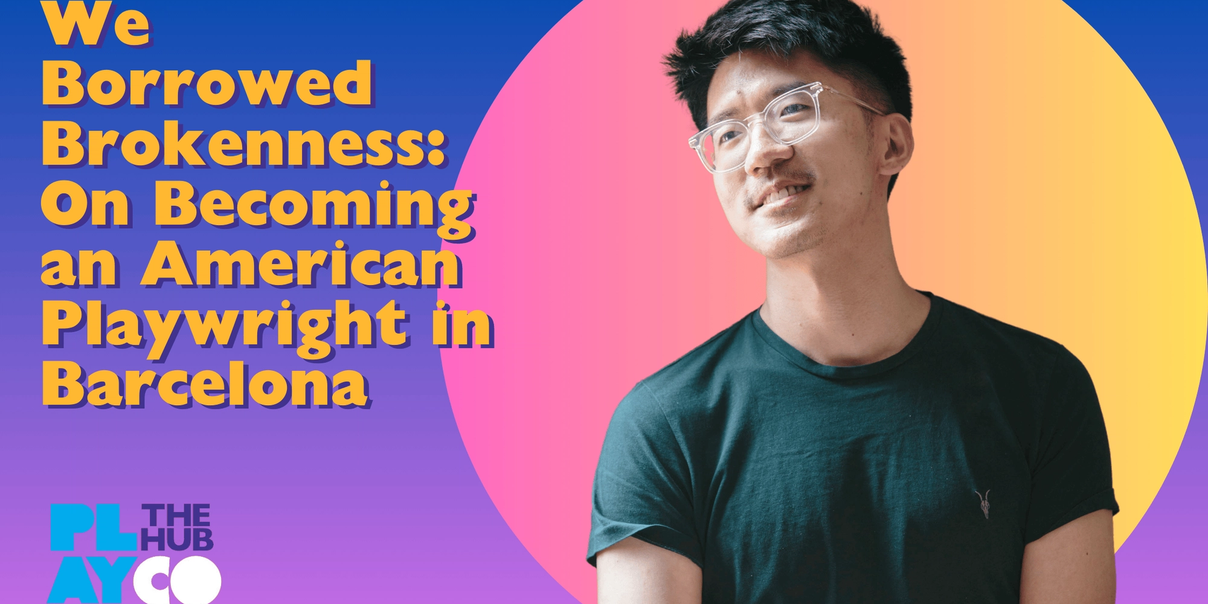
We Borrowed Brokenness: On Becoming an American Playwright in Barcelona
Meet the Participants

Yilong Liu is a playwright in the Juilliard School’s Lila Acheson Wallace American Playwrights Program. His play The Book of Mountains and Seas received the Lambda Literary Award for Drama. His play Good Enemy had its premiere off-Broadway at Minetta Lane Theatre as part of Audible Theater’s 22/23 season. Yilong is a Core Writer at Playwrights’ Center and an alumnus of Ensemble Studio Theatre's Youngblood. He has developed work with Ojai Playwrights Conference, Kennedy Center, and SPACE on Ryder Farm, among many others. Yilong is currently writing under commission for the Manhattan Theatre Club’s Sloan Initiative. Plays include We Borrowed Brokenness (The Juilliard School, Alliance Theatre/Kendeda Playwriting Award Finalist, O'Neill Finalist), The Book of Mountains and Seas (Paul Stephen Lim Playwriting Award), June is the First Fall (Kennedy Center Paula Vogel Playwriting Award, Yangtze Rep, Kumu Kahua Theatre), Joker (Po’okela Award, Kumu Kahua Theatre), Flood in The Valley, a Bilingual Folk Musical (Beijing Tianqiao Theatre Center, Gung Ho Project), PrEP Play (New Conservatory Theatre Center), and Good Enemy (Audible, Ojai Playwrights Festival). Yilong grew up in China and received his MFA from the University of Hawai‘i.
"What's the saddest place in Barcelona?" Pierre Koestel, a French playwright, asked Google on a humid Wednesday afternoon. The answer led him to Plaça de Sant Felip Neri, a quiet, unassuming square in the Gothic Quarter. It was here that children had been bombed during the Spanish Civil War. The limestone walls still bear pockmarked shrapnel scars that tourists often overlook. It's also the same square where Evanescence once filmed a music video. Beauty and tragedy occupy the same frame in this hidden corner of Barcelona. Later, Pierre read his response to us, a piece that traced the imprints of memory in physical spaces. His words resonated with our workshop's theme this year: memory and nostalgia.
We were twelve playwrights from twelve countries, scattered across Barcelona that afternoon with a simple task: go anywhere in the city and write in response to what we encountered. This was Sala Beckett's Obrador d'Estiu, a workshop where, each July, a dozen writers gather in a former workers cooperative that's been transformed into a theater space renowned for fostering new work and international dialogue. What struck me immediately about the space was how it refused to forget its past. The building remembers what it used to be. The architects kept the old ceiling beams, the worn floors, the places where paint peeled away to reveal earlier colors. A palimpsest of a building. The kind that tells you history isn't linear; it's layered.
I'd been drawn to the Mediterranean that day, where the water gleamed with a silver-blue that reminded me of the Yangtze River on summer evenings, when as a kid my family would spend hours by the water seeking refuge from the heat after dinner. That same timeless quality of water somehow connects all the places I've ever called home. Julian Karenga from Norway wrote about children playing soccer in a plaza outside a bar where adults watched the Euro Cup match between Spain and France. The children played with such intensity, perhaps seeing themselves as future stars while Barcelona around them celebrated its advancing team. Each playwright responded through their own cultural lens, filtering Barcelona through memories of elsewhere.
I was in Barcelona as the U.S. playwright, supported by PlayCo and Venturous Theatre Fund, selected for a three-week residency that included this workshop led by British playwright Simon Longman. The irony wasn't lost on me. Though I'd been seen as the American playwright in this international gathering, I was born and raised in China, living in the U.S. for twelve years. This position created a curious architectural paradox. Like Sala Beckett itself, I contained visible traces of different origins and histories. I occupied a curious space between worlds, where my present and past existed simultaneously, where the geography of memory overlapped with the geography of daily life.
I grew up in a river town in southern China, where my earliest memories are colored by water. Its sounds, its smells, its endless movement formed the backdrop of my childhood. When I was eight, my family moved to Chongqing, a sprawling metropolis of 30 million that's now gaining TikTok fame for its cyberpunk aesthetic, its buildings stacked impossibly high on steep hillsides, neon reflecting in the Yangtze River below. But as a child, it was overwhelming and disorienting, this vertical concrete world after the horizontal flow of my riverside home. To cope with losing friends and everything familiar, I turned to books of all kinds - manga, fiction, poetry - worlds I could carry with me, stories that remained constant when everything else changed.
This movement from place to place became the rhythm of my life: Beijing for university, Hawaii for grad school, Los Angeles for a fellowship with East West Players, New York for Juilliard's playwrights program. Each time I've moved to a new city, I bring along fragments of where I've been before—accents that slip through in moments of exhaustion, food cravings that arrive unprompted on rainy afternoons, gestures learned from people I no longer see. I'm fascinated by the pieces we carry with us. These "borrowed" pieces become part of the mosaic that makes me who I am, often integrating so seamlessly into it that I forget which parts are original and which are collected along the way.
This fascination led me to write We Borrowed Brokenness, a play about five organ transplant recipients who come together to run a marathon honoring their shared donor. The title came to me after encountering kintsugi, the Japanese art of mending broken pottery with gold. What struck me wasn't just the beauty of the repair but the philosophy behind it: that breakage and healing become part of an object's history, not something to disguise but to highlight. Similarly, the play explores how we incorporate pieces of others into ourselves—literally, in the case of organ recipients. Does a piece of someone else within you change who you are? What responsibility comes with getting a second chance? And how do we honor and preserve the memory of what came before while creating something new?
Through PlayCo's ongoing exchange with Sala Beckett, this play became my introduction to the Barcelona theater community and eventually led to this residency. Sala Beckett presented a staged reading of We Borrowed Brokenness translated into Catalan by Albert Arribas, directed by Israel Solà. There is something mesmerizing about hearing your work flow into a language you don't understand, like watching a familiar river suddenly branch into unexpected tributaries. As I sat in the audience, I watched Catalan actors embody characters I had created, speaking words that were mine but not mine. Though I couldn't understand the specific sentences, I recognized the rhythm, the emotional turns, the silence between lines. The architecture of the play remained intact, even as its language changed. It was my first time experiencing my own work as both creator and outsider simultaneously, witnessing something both deeply familiar and remarkably new.
This distance from my own work mirrored a larger shift I felt in Barcelona. In American theater spaces, I often feel my "Chineseness" entering the room before I do, carrying political and cultural implications that sometimes overshadow the work itself. In Barcelona, introducing myself as the American playwright without asterisks or footnotes felt like stepping into a space where my presence wasn't a renovation but part of the intended design. My playwright identity stood front and center, not prefaced by explanations or hyphenations. It was strangely liberating. I was simply a playwright whose work had resonated enough to bring me across an ocean.
I remember walking with Josep Maria Miró, a celebrated playwright in Barcelona whose work has profoundly shaped contemporary Catalan theater. He had previously been in residence with PlayCo in New York as the first part of this playwright exchange. He showed me his favorite spots in his neighborhood: hidden paths that revealed the Barcelona skyline, the Grec Theatre where the international summer festival was currently taking place, and the Olympic pool featured in Kylie Minogue's "Slow" music video. We discussed life as playwrights, our creative processes, and the works that had influenced us. "Your plays are very American," he told me. I paused mid-step, unsure how to respond. He continued, "Your characters may carry Chinese memories and navigate between worlds, but the style, the structure, the way you approach drama, that's very American."
What makes a play "American"? The question has haunted me since I moved to America. In Europe, national theaters often have centuries of shared cultural context. But American theater, at its best, has always been a conversation between different Americas: August Wilson's Pittsburgh is not the same as Arthur Miller's Brooklyn, which is not the same as Brandon Jacobs-Jenkins' reimagined South, which is not the same as David Henry Hwang's exploration of Asian American identity. The American dramatic tradition I inherited is itself a magnificent architectural mosaic. Borrowing forms from Europe, stories from immigrants, rhythms from various linguistic traditions. Perhaps what makes American theater American is precisely this question of belonging. Are my plays American? I don't know. The entirety of my formal theatrical education happened in American institutions. The dramatic principles I was taught, the plays I studied, the theatrical canon I absorbed. My artistic DNA is composed of equal parts Chinese cultural memory and American dramatic structure. I inhabit a space between worlds, creating from the intersection of different traditions.
Yet this in-between space, while creatively fertile, can also be isolating. In rooms where decisions are made about what stories deserve to be told, I wonder if my work is often framed as "diverse programming" rather than simply "American theater." The constant reminder of otherness creates fault lines in one's sense of belonging, small fractures that accumulate over time. In these tiny ways, American theater has broken me apart many times. Its expectations, its systems, its blindspots for stories like mine. But each time I put myself back together, I gain new courage, new perceptions, and new insights. Like kintsugi, the fractures become the most beautiful and interesting part of my artistic identity. Perhaps that's what being American is for immigrants: you break me, yes, but I use those very fragments to rebuild myself into something new. The breaking isn't the end of the story. It's where the story gets interesting.
During the Obrador d'Estiu at Sala Beckett, each playwright shared our favorite writing exercise related to memory and nostalgia. We explained the prompts and did the exercises together, then shared what we had created. The writers, from England, Italy, Turkey, Uruguay, Czech Republic, France, Spain, Finland, Norway, Quebec, all communicated in English during discussions, but when we moved to create, we were encouraged to write in our own language. I realized something profound in that room: I was the only one writing in a language I didn't grow up using. My childhood exists in Chinese, my grandmother's stories live in Chinese, yet I create in English. It hit me suddenly that English is becoming mine without my realizing it. There will come a point where I will have used more English than Chinese in my lifetime. Like an organ recipient, I've incorporated something foreign until it became essential to my survival.
It's a strange moment to be Chinese in America, with trade wars escalating, suspicion growing, and cultural exchange programs diminishing. Headlines about Chinese researchers and students facing increased scrutiny make me wonder about my own place within American theater. The very borders of the "American" identity are being reinforced at the same time that my own work increasingly blurs them. Perhaps this is why the architectural paradox of my identity feels so haunting. It captures not just a personal contradiction but a political one. The more "American" my theatrical sensibilities become, the more my Chinese identity gets highlighted as different, foreign, other. But in that workshop room in Barcelona, separated from these tensions, I found myself thinking what if this paradox isn't just a burden but a source of beauty and strength? If my plays can break audiences open, even just a little, when they put themselves back together, is there a piece of "otherness" now living inside them? Will they find a way to make that otherness theirs?
I often wonder why we use words like "diverse" or "multicultural" to describe plays by immigrants, as though there is a default "American" play against which everything else is measured. The tapestry of American theater should by definition include threads of different colors, textures, and origins. Yet so often, immigrant narratives are treated as specialty items, as though they exist only to provide perspective on "real" American stories. In Barcelona, freed from the constant awareness of being a "Chinese American" playwright, I found myself thinking about what American theater could become if it treated immigrant narratives not as additions to the canon but as central to its identity. What if, like Sala Beckett, American theater didn't try to hide or smooth over its historical fractures but instead highlighted them, made them the most beautiful part of the structure?
When Victor Muñoz, the director of international programs at Sala Beckett, walked me through the building on my first day, I fell in love with the space immediately. My eyes lingered on the peeling ceiling roses, original floor tiles, fading decorative windows and doors. An inventory of what the architects Ricardo Flores and Eva Prats describe as the "ghosts" from its past. "The building's state of decay interested us," they shared in an interview, "not with a view to returning it to its original condition, but rather of bringing the ruin forward in time, making it participate in a new reality." The building holds all of its histories. It doesn't hide its contradictions. It celebrates them.
Perhaps our own contradictions too aren't problems to solve but foundations to build upon: to make our memories, our languages, our contradictions participate in a new reality. As writers, we salvage fragments of memory and transform them into new stories. As immigrants, we carry pieces of home into foreign landscapes. As humans, we incorporate our breaks and mends into who we become. Perhaps that's also what it means to be an American playwright: to exist in the creative tension between origin and destination, between mother tongue and borrowed language, between what was broken and what has been beautifully rebuilt. Sala Beckett reminds me that we are all bringing ruins forward in time.
Isn't that what theater is? Bringing the ruin forward in time.
Press & Related Media
Written by
Yilong Liu