Amm(i)gone

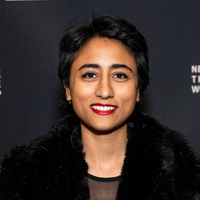
Fatima A. Maan is a theatermaker, administrator, and educator born and raised in Lahore, Pakistan and currently residing in Brooklyn. She received her MFA at the Boston Playwrights' Theater and undergraduate degrees in Theater and Economics at NYU Abu Dhabi. She currently works as a Development Associate at the New York Theater Workshop. Fatima is deeply drawn to character-driven narratives that explore the paradoxical nature of human existence and connection. She is most determined to depict relationships that are at once frustrating, empowering, and above all real. Inspired by the power of theater to unravel what we know most intimately, Fatima’s plays center the complex sociopolitical nuances that characterize lived experience in South Asia. Her plays have been performed in multiple cities across Pakistan as well as Abu Dhabi, London, Boston, New York City, and more.
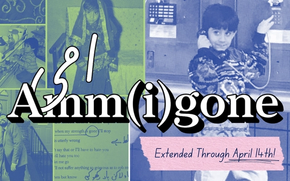
It was a beautiful June morning in NYC as my playwriting cohort mates JC, Elise, and I boarded the Metro North to New Haven, discussing the possible pronunciations of Amm(i)gone. Being a Pakistani playwright myself, I was excited to see something about our shared culture on American stages, but I did not anticipate being emotionally wrecked by it.
Adil played the first recording of his conversation with his mother and as her voice filled the theater, I felt the tears trickling down my face. Somewhere between the expansiveness of her love for her Adil, the realization of a dream unsaid, and the nervous excitement on both ends, I was immediately transported to terse stalemates with my mother. If Adil and his mother see themselves refracted through the relationship of Antigone and her sister Ismene, their mother-son relationship becomes a conduit for observing my own. Adil’s earnest attempt to recover a closeness with his mother by utilizing language as a project, in a moment he is struggling to find the words to articulate the distance that has cemented itself between them, is one that spoke to my own relationship with my mother which similarly feels like a relic of what it used to be. Lucky for me, JC held my hand through the rest of it.
It’s a strikingly simple play, Amm(i)gone. As Adil sets the scene by introducing us to his mother, their relationship, and himself, we know exactly what to expect from the get-go, but as he gently peels back fraught layers and the facts unfurl, we are forced to encounter the devastating reality that sits at its searing core. Despite Adil and his mother’s muhabbat ("incomprehensible love") for one another, there may never be a reconciliation of their differences.
Much of the Quran’s guidance is towards searching for meaning in life and wayfinding. Listening to Adil and his mother take tender steps towards each other as they talk about Ismene and Antigone’s love for each other is heartrending. The inherent bravery in finding common ground and creating a path forward, where no prior examples exist, is as queer as it is Islamic.
Being raised in a culture that values community above all can be discombobulating in a setting as steeped in individual progress as America. I felt the tug of both influences most strongly during my MFA at Boston Playwrights’ Theater. My thesis play, Jado Jehad (“to be in effort”) required me to think deeply about the impact of American expectations on a play, and my work at large, situated in Pakistan. The protagonist of Jado Jehad, Mashal, has returned to Pakistan after her undergraduate education abroad and is learning to reside with her recently-divorced mother and omnipresent grandmother. As the three of them release long-held grief and find ways to take care of each other, they forge a new life together.
Throughout the development process, I had to explain to multiple American directors that my protagonist will not put her foot down to her mother and grandmother in a stand-off for acceptance. That an ultimatum is not the next best step for dramatic tension or stakes (or whatever you want to put in there that sidesteps the hard work of understanding a culture that isn’t yours. Of course that burden lies squarely with us!) “Why?” They always asked, incapable of understanding a love that requires us to hide parts of ourselves to exist (nevermind the parts of ourselves we have to amputate to be digestible to them in their spaces) because our love for and sense of duty to our loved ones extends well beyond the simplicity of personal ambition or a binaristic idea of acceptance. Adil’s mother’s insistence on bringing him back into the fold of respectable Islam mirrors Adil’s desire to find common ground with her by undertaking a translation of Antigone together. We make choices that extend beyond anger and reproach but instead are steady, brave steps to appeal to each other’s sensibilities. And if we can see the depth of Antigone and Ismene’s love, we can most certainly see a Muslim mother’s love for her queer son.
The situation of Antigone at the core of this play, and its parallel to Adil’s relationship with his mother, is a choice that not only helps Adil and his mother find their way towards each other but also situates queerness in a Muslim context without the need to point fingers or identify a bad guy. Honing in on the relationship between Antigone and Ismene allows us to see Adil’s relationship with his mother for the love it is full of. Both want nothing but the best for each other, and such is the impasse of their relationship. And such is the beauty of this play, allowing us to understand their relationship, and consequently, our own relationships with our loved ones beyond the realm of right and wrong.
It is the same community-centric nature of Pakistani culture that makes silence so accessible and words so challenging sometimes. Maintaining silence or letting things happen under the radar are choices widely understood to be for the greater good. And yet, Adil resists this expectation as well. Throughout the play, he seeks the comfort of words. Adil plays a video recording from his childhood and yearns for his father’s voice, an audio recording of his mother as she switches from Urdu to English in an attempt to explain her feelings, and a recording of them grappling with the enormity of Ismene’s love for Antigone. He strings together words to explain what the silence around his queerness has done to his relationship with his mother, how it impacts the way he shows up in his own life. In finding these words, Adil resists the Pakistani expectation to maintain silence. It is quite the undertaking, resisting the expectations of both cultures he has grown up in and insisting on finding a way through both.
Perhaps my favorite thing about Amm(i)gone is how fully it captures both Adil and his mother, and consequently, the depth of their relationship. Presented as their most fulsome selves, Adil and his mother can’t help but love each other. Despite their separate worldviews, care unites them. The depths of this care show through small moments in the play. In being careful about sharing her photos without her hijab and remaining cognizant of how hijabi women and their faith are perceived in America as he talks about her, you can feel Adil’s adoration and protectiveness towards her. In telling us about himself, sharing recordings of them laughing, and peeling back the layers of their relationship, Adil puts himself front and center. His gentle demeanor shines at every corner, and as he shows us his truest, most vulnerable self, he invites us in. This vulnerability, tied with abundant love, is what makes this play so relatable.
Being a queer Muslim can mean many difficult things, especially in the charged theatrics of contemporary America. Silence, shame, and translation become an intertwined mess and much of our lives are spent trying to make ourselves palatable and non-threatening. As much as the American understanding of a ‘Muslim’ has impelled us to be a certain way, Amm(i)gone stands in gentle resistance, redefining for the canon how we are with each other and how we can and should be perceived.
Fatima A. Maan