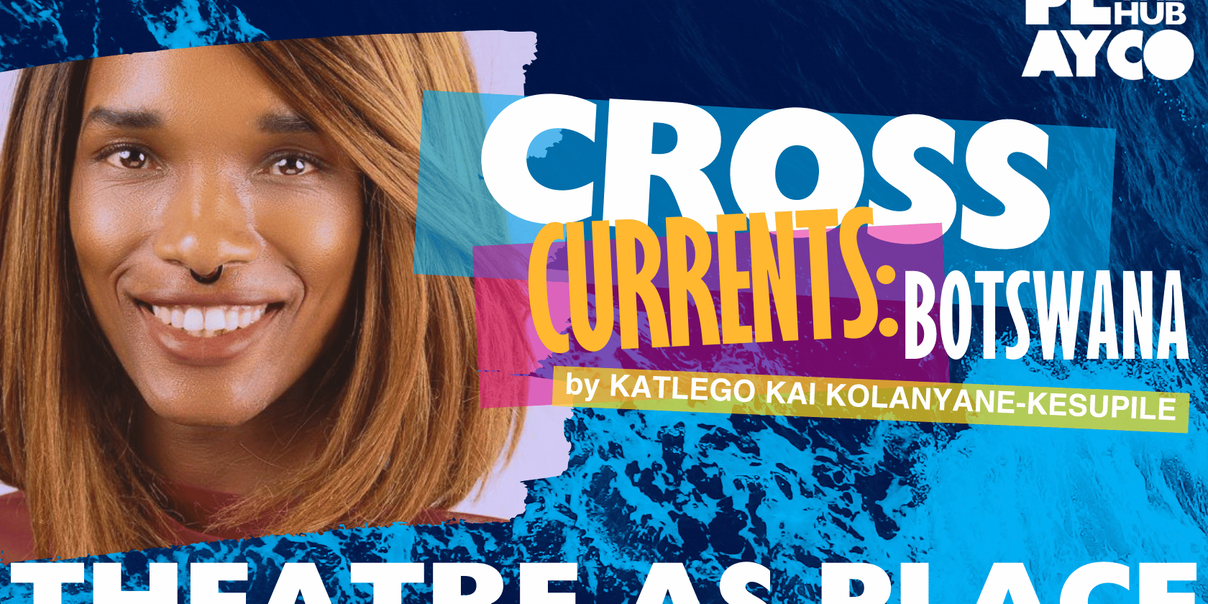
CrossCurrents: Botswana - Theatre As Place
Meet the Participants

Katlego Kai Kolanyane-Kesupile is an international award-winning cultural architect, Development Practitioner and Interdisciplinary Artist from Botswana. Her work in human rights, education, and communications centers decoloniality, feminism and Disability theory. Katlego is a classically trained singer and composer, theatrical performer and designer. Her published writing ranges from contemporary critiques, creative work in poetry, music and theatre, and scholarly research. Katlego is the founding director of the Queer Shorts Showcase Festival (Botswana’s premier LGBTQ-themed theatre festival) — for which she has written numerous works and mentored performers and writers, and founder of the Writers’ Meet Social Club. Her accolades include being a TED Fellow, Chevening Scholar, OkayAfrica #100Women honoree in the Arts, Mandela Washington Fellow, and CACE Africa Writivist. She holds an MA in Human Rights, Culture and Social Justice from Goldsmiths University of London, and a BA (Hons) in Dramatic Arts from the University of the Witwatersrand.
A goat bleats and the confused cockerel launches his morning song to the setting sun. You perch on a log chopped by one of the herdsmen from a tree they’d assessed before repurposing it for security. The salty sweat on your forehead moves slower now, but still catches the rising dust as you double over laughing at your elder cousin who presently lies face down in the motshetelo [1]. A stubborn calf refuses to leave its mother’s side, but it is the season for them to be weaned – or so you’ve heard the adults say. You observe the scene passively, yet somehow you know you will speak of this at the fireside. You have been raised with tales of the day as entertainment once grandfather has turned down the dial of the radio after the national obituary broadcast is done. Unlike the radio, everyone’s batteries don’t need that much saving. You live this, and don’t know how to call it otherwise.
The theatre of life is something greatly rooted in the ways of navigating the world. It is in the living and retelling of memories owned – or sometimes borrowed – that the dos and don’ts become nature, law and refuge. Without speaking about us in historical terms, many an African has a story whose telling was either an event or has imprinted itself upon their psyche; but a structure doesn’t prescribe theatricality. What then becomes a challenge (and opportunity) to those wishing to bring the textually regulated practices of what is oft conjured when one hears the word theatre, is whether the living of it is fictional enough. It would be erroneous to assume that the lack of scripted parameters means complete informality. Even in the homestead, unspoken parentheses guide what tales audiences may be regaled with.
Botswana, like many African countries, has been living the realities of globalization for as long as the term has been in the public sphere since its coining by Theodore Levitt in 1983. Having gained independence in 1966, the young country has been playing a dualistic game of identity formation and cultural preservation. In this game best embodied through the metaphor of the Akan legend of Sankofa, Botswana and her African peers have been working towards shattering the taboos of returning to fetch the cultural and traditional assets that are at risk of being left behind in pursuit of textual formality. This Ghanaian Twi cultural offering serves not only as a foreboding term, but also a point of reconciliation – reminding us that it is never too late to find what sits with the self as true.
Truth, however, is but one aspect of the theatre of life. When in the household, each member plays a role. Some are pre-cast while others emerge because of the presence of empowering or antagonising forces. As such, thinking back to the scene of the cousins at the kraal[2], the order of things is governed by age. It is then age that prescribes ability. Speaking in terms of formality and informality, age sits as the surrogate for establishment, permanence, and official authority. This is something that continues as a running struggle in countries, and among industries, that are forever considered burgeoning. Botswana is one of these.
One of the truthful legends of Botswana is that there had only been 12 km (7.5 miles) of tarred road in the entire country at the time of gaining its independence in September 1966. We look back now and the country that had been a protectorate of Britain has established its own narrative of stability and economic prosperity. Stories such as these remain important in the building of a national pride. However, even with the investments that have been made in sectors across such as sports, agriculture, commerce and education, there is a glaring under-recognition of the needs of creatives for structures that enable their exploration of narratives old and new. Yet, in their unique way, the storytellers haven’t ceased to pursue the charge of crafting and commenting on life as they know and imagine it.
Starting in the homestead, the generation that bore the children who rang in the dawn of independent Botswana taught them and their offspring life lessons in the same ways that they had been taught. Oral traditions were integral to teaching in both formal and informal settings due to inequitable levels of literacy. Using story – be it fable, allegory, song or another form – elders imparted principles and values unto the youth. When time allowed, these stories would go beyond a single orated form and transform into grander performances. Yet, none from within would consider their actions ‘theatre’, or the Setswana: ‘bodiragatsi’ – a term referring to the performativity of doing.
Turning our focus to the world outside the nuclear family, communal structures appear. Often traditionally arranged as compounds, familial homes allowed for the intermingling of different branches of the same tree in a common space. This, consequentially, meant that John Donne’s idiom that “no man is an island” was a lived reality. The weaving of personal stories feeds into the weaving of the performances of life. The traditional dance forms, songs and stories told around the fire in the courtyard become ties that bind on the plains of hearts and minds. The mischief and talents displayed by an elder brush smiles across the faces of youngsters who’ve only ever seen them as disciplinarians. They themselves enter an unspoken contest of showmanship, each seeking to show their uptake speed and retention. Thus, the community of players is formed.
From suckling bodiragatsi as naturally occurring, to sharing with strangers to bide time and build bonds, the skill behind mastery of performative storytelling often unfortunately gets underplayed. As a consequence, dedication to it gets undervalued. While acknowledgement is given to the role storytelling plays in the enactment of culture, with the loss of the aforementioned embodied structures due to globalization and urbanization, the reverence fitting to the resident wordsmith, singer or dancer wanes as well. However, it is in being able to share in the show of veneration that the sparring and bestowing of traditions can be continued. Wistfulness may lead one to believe that the best means of returning to the ways of old is to build structures in which they may be re-enacted; yet wisdom would say otherwise.
In the 58 years of independence, Botswana has overlooked the use and the place of theatrical infrastructure. Much like the traditional kgotla where communities were called to convene for important events, community centres were erected to provide some formality and show development. Community centres gave space for choirs, traditional dance troupes and amateur sketch groups to display their wares. As rudimentary structures, they’ve served as blank canvases against which the colours and textures of story, dance and song could be splashed in temporary splendour, but never stick. They’ve served as both destinations and transitory spaces, and the few that are still accessible continue to do so today.
Fortunately for creators, the underinvestment in theatrical infrastructure hasn’t repressed the possibility of engaging in age-old artforms. Resilience has gone hand-in-hand with adaptability, albeit often at the expense of innovation. Traveling across Europe, and in many of the settler-colonial states on the African continent, one isn’t hard pressed to find buildings which were purposefully built for congregation and celebration of performance. These institutions not only enabled the imagination of the value of theatre, but also serve as advocacy tools for due recognition of artists today. In Botswana, the necessity for cultural bonding continues to keep the artforms buoyant and relevant to national teachings on morality and health, and campaigns for road safety and electoral responsibility among other causes. Yet, it cannot go without saying that “theatricality” as a term has yet to be formally recognized beyond such realms. One can’t help but wonder if this is due to the lack of structures that could serve as modern extensions of the gathering points of old.
By and large, the infrastructure of theatre comes with rules of the establishment, which, perhaps, are not necessary or haven’t been imagined as adaptive to the ways of engagement that have long been the norms of communal storytelling. The mobility granted by firesides is complicated by erected structures. The diplomacy of even viewing, performance planes and participation gets corrupted by spectator-performer relationship divides that are often imposed by formality. This divide feeds the growth of other separations if it goes unobserved – where being a player is restricted to those being observed alone; with or without a fourth wall.
A wonderful challenge Is thus presented when looking at theatre as place/space or infrastructure: how do we make intelligible the theatre of life as a reference demanding innovation for the purposes of being able to be valued by structures that otherwise undermine theatre overall? On the inverse, the question arises whether this question should be posed at all. With or without infrastructure, the exercise of finding homes for stories that would otherwise be deemed unfitting of the locales in which they could be told – stories of those experiencing marginality, or those foregrounding unflattering truths – continues. The legacies enabled by formal structures cannot be denied. There is a permanence and promise of memory – even if false – implied by the existence of formally recognized institutions and what they deem worthy of attention. The consequence of lack in the case of Botswana is that while there exists over six decades worth of performative storytelling, few records exist of this wealth, thus affording (benefiting? accommodating?) those who continue to undermine the craft through denialism.
At sunrise, the cockerel crows once again as it has done before. A distant figure approaches, growing in size with each stride. A pail loaded with expectation swings slowly from a hanging arm. Perhaps today the cow produced its white nectar with no fuss, perhaps it loosed its hind leg from the lasso and knocked the pail over after sticking its hoof in it. Watching the figure approach, you know anything is possible. You wait for the telling of it to bring the events to life, and for a new memory to be formed. The fireside awaits, for every story has its place.
[1] Motshetelo n. the dried dung, leaves, and sand on the ground of a livestock kraal.
[2] Kraal n.an enclosure for cattle and other domestic animals in southern Africa
Press & Related Media
Written by
Katlego Kai Kolanyane-Kesupile