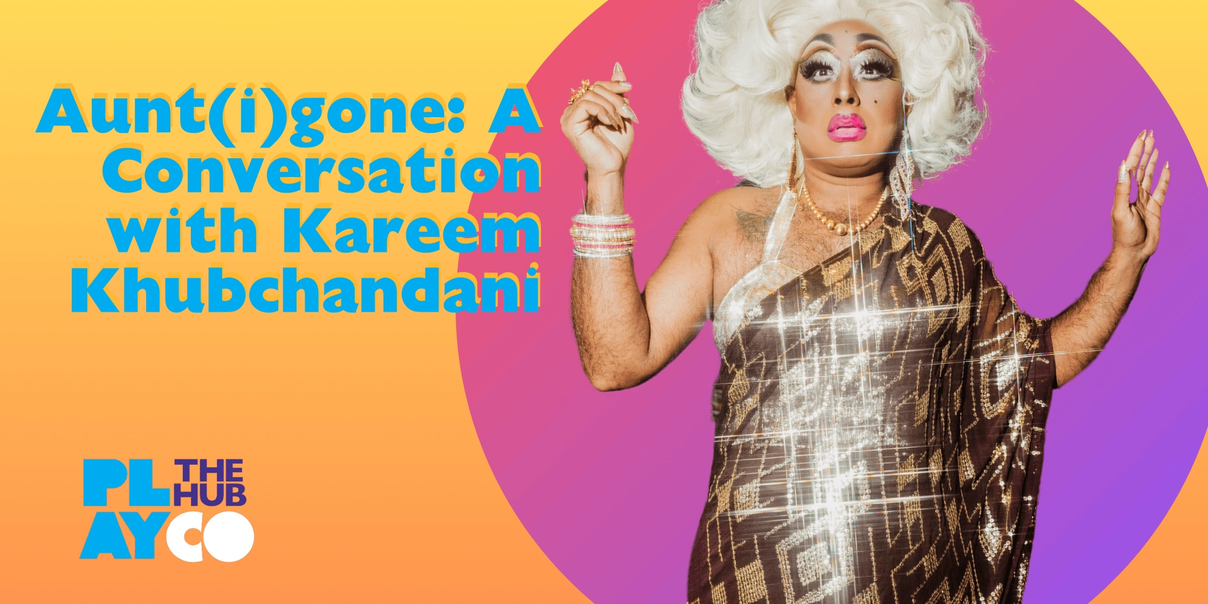
Aunt(i)gone: A Conversation with Kareem Khubchandani
Meet the Participants
LaWhore Vagistan is your favorite auntie’s favorite auntie—overdressed, overeducated, and overopinionated. In 2009, she co-founded the queer South Asian party Jai Ho! in Chicago, and in 2023, she launched Dragistan, an annual South Asian drag showcase in New York. Auntie is also a published author--you can buy her very shiny book Decolonize Drag through most bookstores or online platforms, a TedX speaker—look up "How to be an Auntie" on YouTube, and a mediocre singer—you can find her parody of Justin Bieber’s sorry, called Sari, online.
SHER JAMAL STONE: So, could you tell me a little bit about yourself, your background and how you found your way to Adil Mansoor and his play Amm(i)gone?
KAREEM KHUBCHANDANI: My name is Kareem Khubchandani, and I also perform as LaWhore Vagistan, your favorite auntie's favorite auntie. I am an associate professor at Tufts University, where I teach classes about gender and race and teach a lot about drag and the South Asian diaspora.
I started my academic and performance career in Chicago from around 2008 till 2014. While I was there, I was part of a South Asian LGBTQ+ organization called Trikone and I hosted their first arts festival called KalaKranti. And I asked every single person in Chicago if they knew any South Asian queer performance artists, and someone gave me Adil's name, and I invited Adil to be part of this show. And since then, I've been keeping track of his work. And even though we moved to different cities and lost touch with each other, he found his way to Boston through The Theater Offensive, which is a Queer Theater organization here, which I was on the board for. And so we re-established our connection there. You know, this was deep COVID times, so I got to see and workshop Amm(i)gone for The Theater Offensive via an online workshop and presentation.
SJS: So that was your first encounter with Amm(i)gone. Have you encountered it since? I know the show has gone through many iterations and since toured.
KK: You know, I have no idea what it looks like right now, and I'm excited to see it live and in person. When I saw it, it worked really well as a digital performance. So I actually don't know what it's gonna look like onstage.
SJS: The way Adil has discussed it, I don't think he has shied away from the idea that Amm(i)gone is a lecture performance in a way, as well as being theatrical, so I can see how it could also work in a Zoom call as well. Could you say a little more about what excited you about the play in that particular context, or drew you to it in that moment?
KK: The show in that iteration was a lot like a podcast, actually. You could see the mic, you could see his desk, you could see the Post-Its. It felt like the site where the show was probably written was, in fact, the stage. So the textuality of the show really lent itself to that environment.
But what was really special to me about the show was Adil engaging with their mother and having difficult conversations that were channeled through text: Antigone and the Qur’an. They were using other people's words to communicate with each other, texts that were really important to each of them.
I think a lot about pedagogy as a professor, but also in my research. One of my research topics is the idea of the South Asian auntie who's often dismissed for her age–that she has nothing to teach us, and that she is just a gatekeeper. And in this show, you see Adil engaging with his mother as someone who teaches and has a lot to offer, and that intergenerational exchange and pedagogy is possible. And I just thought that was really beautiful and smart, and transforms the way we think about cross-generational care.
SJS: That's great. And you jumped ahead to my next question where I was going to introduce you as an expert “auntologist.” I don’t know if that’s your preferred title.
KK: I love it. I'll take it.
SJS: But in your words, what is an auntie and why does the term have such a special place in the South Asian diaspora?
KK: So aunties are those figures who orbit the nuclear family. They're your mom's friends and relatives and neighbors. They get a bad reputation for being unkind, ungenerous, dangerous, surveillant. Because they're like on the border of the family, they can watch you, right? They see you leaving the house, and they'll ask your mother, “Where was your child last night? Where was he going?” But there's also something magical about being at the periphery of the family, because just as they can gatekeep and foreclose what's possible, they can open doors, and sneak queerness and pleasure into the household when it's not already there. You think of all the ways that aunties bring gossip into the home, and they bring food in from abroad, and they give you permission to do things that your parents might not and can cover for you as well. So they're these kind of double agents that I think are really exciting. I think aunties are special because they have so much promise that we don't see all the time. And I'm actually really excited to think about mothers and aunties together by being in conversation with Adil.
SJS: And I remember, being a kid in Pakistan, you would call everyone who was older than you auntie or uncle. But then you grow older, and as an adult, it can be demeaning. And so it's interesting to see the term’s ubiquitousness. It can be shady, it can be messy, it can be queer, it can be all these other labels or definitions.
KK: And it can be sexy. One of my favorite things are sexy aunties. Because we have to protect the mother, she's kind of sacred and goddess-like, so she has to be demure. But aunties can be dangerous and sexy and go out and be single. We afford aunties a lot more than we afford mothers. What would it mean to group our mothers in with our aunties? As opposed to separating them out as someone exceptional or sacred in that way.
SJS: I saw that you're working on a tome for the aunties, is that right?
KK: So I'm working on a book called Auntologies that thinks through the different iterations of aunties. It isn't trying to save the auntie from her bad reputation, but indulge in it and ask what we can learn from this popular figure through her aesthetic form–her fabulousness and her penchant for gossip, her big hair and her fat body, and, as she is stereotyped in a lot of South Asian popular culture, her accentedness. And all these things that she's disliked for, I think are actually very precious ways of being in the world.
SJS: How did you first find your way to LaWhore Vagistan?
KK: There are two moments. I had never done drag performance before, until I got to Chicago, and in grad school, I had to make up a performance, and I tried her on. It was a one-time thing, but I had bought the clothes and the makeup, and they were expensive, so I was like, “Let me use them again.”
And then we threw this party to fundraise for Trikone called Jai Ho at a bar called Big Chicks in the Uptown neighborhood of Chicago, so I performed as LaWhore there. But, the thing is, the fundraiser kept happening, so I kept performing. It just kept building on itself, and I got invited to perform at other places, and started creating my own show out of it. And I made an Instagram account so now LaWhore has to post and keep her audience happy. So that's how I got to LaWhore. It was not a long term, intentional framework for performance. It was really just people asking, “What are you going to perform next time?” And I was like, “Oh, you want me to perform? Okay, I'll keep going.” And built from there.
SJS: What do you think brings audiences to LaWhore? What do you think people are drawn to about her?
KK: Oh, wow. You’re asking me to compliment myself? I would say that there's a real audience for South Asian drag, especially because there have been very, very few South Asian artists on RuPaul's Drag Race, which is where we look to when we look for drag. So there are all these brown folks who are eager to see themselves, their cultures, their languages, their aesthetics reflected back to them. I also think people like to be bullied and dominated by drag queens. And so being a Professor Drag Auntie and walking to the room with that kind of authority and confidence actually provides a little bit of comfort. You know? Drag is very powerful in instructing people on how to behave: how to be at the club, how to be kind to each other, how to feel good about yourself. At the top of a drag show, the host comes out and is like, “Y'all look so good!” That actually does really important work. You know, we walk into these nightclub spaces and they're actually very vulnerable spaces where we may not know a lot of people, we may not feel very good about ourselves, we may not feel like we have anything in common with strangers, but then drag gives us a reason to be there together. And that, to me, is what Professor Auntie Drag Queen does, is she's really reassuring as to why we're in the room together.
SJS: Can’t wait to meet her! And what can people who come to your AuntieSocial event expect?
KK: So LaWhore is trying to make it beyond the academy and start her own daytime nighttime talk show. And so they can expect a little bit of Ricky Lake, a little bit of Maury Povich, a little bit of Simi Garewal, and a lot of lip sync.
SJS: It's Oscar season, and the lead runner in nominations, Emilia Pérez, has been getting dragged because Karla Sofia Gascón has called Islam incompatible with Western values and unironically referred to Arabs as “Moors.” What would you say to people who think that Islam and queerness cannot be held in tandem?
KK: The Professor answer is that this notion is a gross colonial relic of Orientalist degradation and fetishization of brown bodies that, on the one hand, hypersexualizes them and, on the other hand, desexualizes them. And these sexual representations have been at the core of justifying colonialism over centuries. That's the kind of academic answer. The other answer is that queerness is really beautiful, as is Islam. And it's really easy to see how gorgeous they are together. And you just look to the many Muslim drag artists around, from Lady Bushra to Mango Lassi, and Asifa Lahore, who just make it look so good. How can you deny it?